
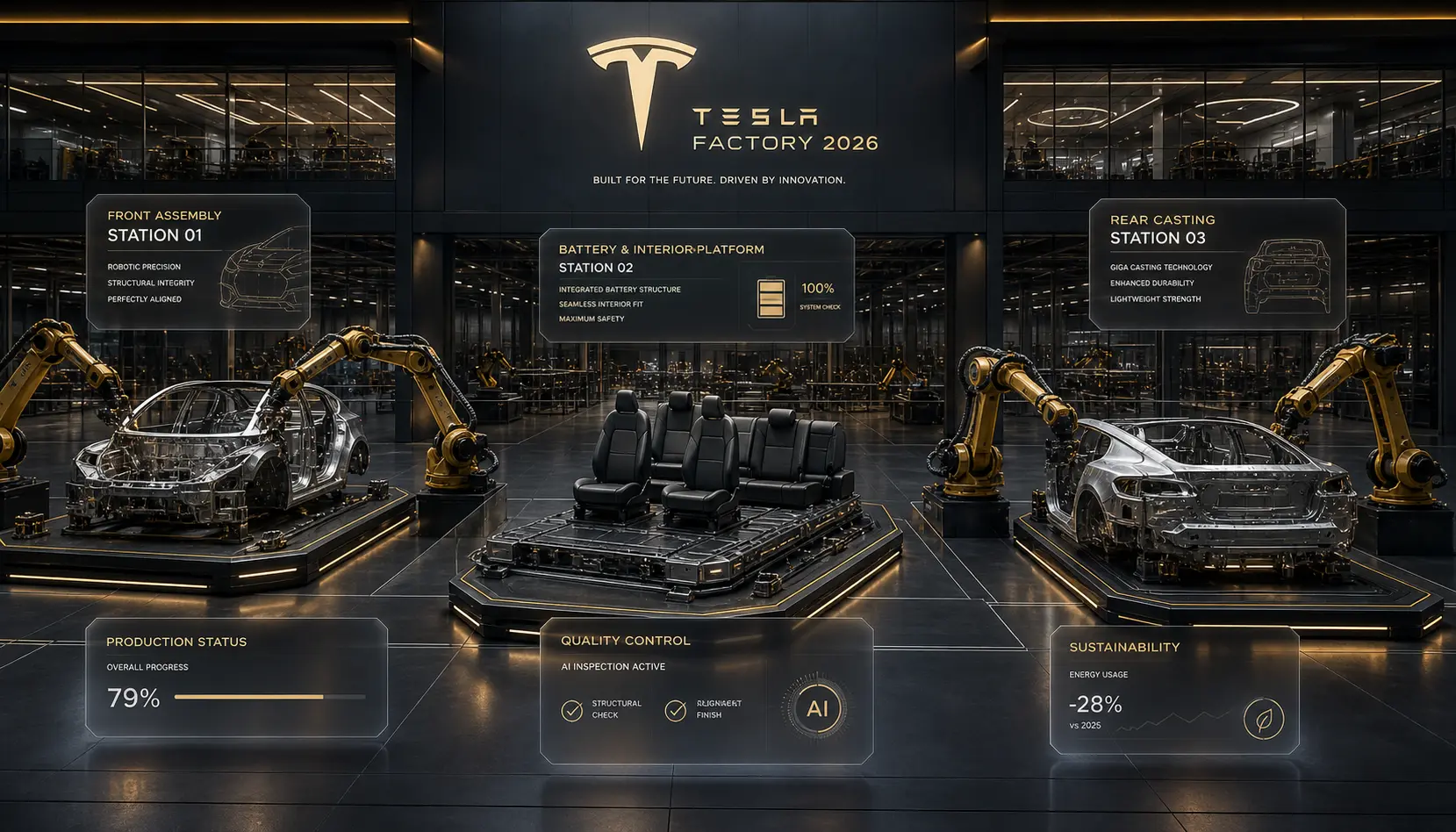
For over a hundred years, the world built cars the same way Henry Ford did: a long line where a chassis moves slowly while workers bolt pieces onto it. But in 2026, the walls of Giga Texas are witnessing something radical. Tesla’s "Unboxed Process" isn't just a small upgrade; it’s a total teardown of how a vehicle comes to life.
If you’ve been following the EV market, you know that the biggest hurdle isn't range anymore it's price. The Unboxed Process is Elon Musk’s secret weapon to finally bring a $25,000 Tesla (often called the Model 2 or Project Redwood) to the masses.
What Exactly is the Unboxed Process?
Traditional manufacturing is linear. If there’s a delay at the paint shop, the whole line stops. Tesla’s new method breaks the car into six distinct modules (or "boxes").
Instead of painting the entire car body at once, Tesla paints only the necessary panels. The interior seats are bolted directly onto the structural battery pack, and the front and rear sections are "Giga-casted" as single pieces. These sub-assemblies happen simultaneously in different parts of the factory and only meet at the very end for a "final snap."
Bureau Verification Tools
Key Benefits of Modular Assembly:
-
40% Smaller Footprint: Since you aren't moving a giant car body through the whole factory, you need much less space.
-
50% Cost Reduction: Fewer parts and faster assembly mean a cheaper car for the consumer.
Strategic Intelligence Master Edge Computing for 2027 Success -
Parallel Productivity: Operators work on different sections at the same time, eliminating the "bottleneck" effect.
Snippet: The 2026 Manufacturing Shift In February 2026, Tesla officially moved the Cybercab production to the full Unboxed flow. Reports suggest the cycle time has dropped significantly, aiming for one finished vehicle every 10 seconds.
UP NEXT FOR YOU IoT for Sustainability: Save Millions Now!Strategic Intelligence Edge Computing Costs: Savings or Strain?
The Role of Giga-Casting and Structural Batteries
You can't have an "unboxed" car without Giga-casting. By using 9,000-ton presses, Tesla replaces hundreds of small welded parts with just two or three massive aluminum castings.
When you combine this with the 4680 structural battery pack, the battery itself becomes the floor of the car. This reduces weight and increases safety, making the assembly look more like a Lego set than a traditional mechanical machine.
Impact on the Global EV Market
While competitors in Europe and China are still trying to optimize the old way of building, Tesla has changed the game's rules. For a platform like Factorahub, where we track global strategy and tech shifts, this is a clear "Market Signal." If other manufacturers don't pivot to modular assembly, they simply won't be able to compete with the pricing of next-gen EVs.
Planning to invest in EV tech? Use our [Currency Converter Tool] to check global market rates.
Bureau Discourse
Participate in the Analysis
Your contribution is subject to editorial moderation.