
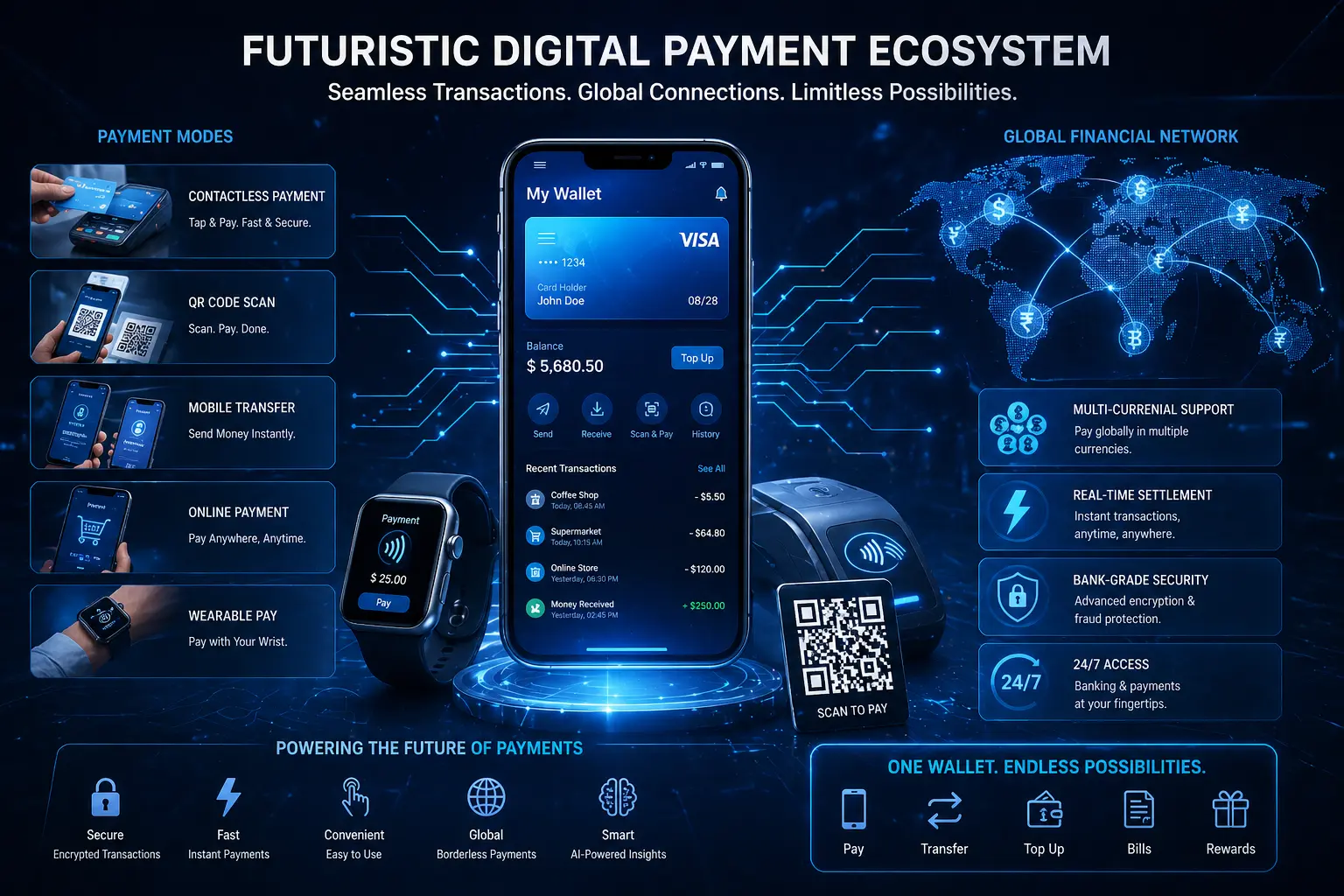
The way money moves is changing faster than most people realize. Cash, once the backbone of everyday transactions, is steadily losing its dominance. In its place, a wide range of digital payment systems are emerging faster, more convenient, and deeply integrated into modern life.
From mobile wallets and contactless cards to real-time bank transfers and decentralized payment networks, the shift toward a cashless economy is no longer a future concept. It is happening now, across both developed and emerging markets.
Understanding this transformation is not just important for financial institutions it is critical for businesses, policymakers, and consumers navigating an increasingly digital financial landscape.
🌐 What Is Driving the Shift Toward Digital Payments?
Several factors are accelerating the move away from cash.
Convenience is one of the most obvious. Digital payments eliminate the need to carry physical money, making transactions faster and more efficient. Whether it’s paying for groceries, booking services, or transferring funds, digital platforms simplify the process.
At the same time, smartphone adoption has played a massive role. With billions of users globally, mobile devices have become the primary gateway for financial transactions.
Government initiatives are also pushing the transition. Many countries are actively promoting digital payment systems to improve transparency, reduce tax evasion, and strengthen financial inclusion.
💳 Evolution of Payment Technologies
Digital payments have evolved significantly over the past decade.
Early systems focused on card-based transactions. Today, we see a much broader ecosystem that includes mobile wallets, QR code payments, biometric authentication, and real-time settlement systems.
Fintech companies have introduced innovations that challenge traditional banking models. Peer-to-peer payment apps allow users to send money instantly, while integrated payment gateways enable businesses to operate globally with minimal friction.
The introduction of blockchain technology has further expanded possibilities, enabling decentralized payment networks that operate without intermediaries.
🔐 Security Challenges in a Digital Payment World
As digital payments grow, so do security concerns.
Fraud, data breaches, and unauthorized access are persistent risks. Unlike cash transactions, digital systems rely heavily on data exchange, which creates potential vulnerabilities.
To address this, financial institutions are investing in advanced security measures such as encryption, tokenization, and multi-factor authentication. These technologies help protect sensitive information and ensure transaction integrity.
👉 Verify secure transaction environments using our SSL Checker before integrating payment systems.
📊 Role of Data in Payment Systems
One of the defining features of digital payments is the amount of data they generate.
Every transaction provides insights into consumer behavior what people buy, when they buy it, and how they prefer to pay. This data allows businesses to personalize services, optimize pricing strategies, and improve customer experiences.
However, it also raises important questions about privacy and data ownership. Striking the right balance between innovation and protection remains a key challenge.
🌍 Impact on Businesses
For businesses, digital payments are more than just a convenience they are a strategic advantage.
Accepting multiple payment methods increases accessibility and customer satisfaction. It also enables businesses to expand beyond local markets, reaching global audiences without the limitations of physical currency.
Operational efficiency improves as well. Automated payment systems reduce manual processing, minimize errors, and streamline financial management.
👉 Calculate cross-border pricing and margins accurately using our Currency Converter.
🏦 Financial Inclusion and Global Reach
Digital payments have the potential to bring millions of unbanked individuals into the financial system.
In many parts of the world, access to traditional banking services is limited. Mobile-based payment solutions provide an alternative, allowing users to store, send, and receive money without a formal bank account.
This shift is particularly significant in developing economies, where digital finance is driving economic participation and growth.
⚡ Real-Time Payments and Instant Settlements
Speed is becoming a defining factor in modern payment systems.
Real-time payment networks allow transactions to be completed within seconds, regardless of location. This is a major improvement over traditional systems, which can take hours or even days to process.
Instant settlements benefit both consumers and businesses, improving cash flow and reducing uncertainty.
🔁 Regulatory and Infrastructure Challenges
Despite rapid growth, the transition to a cashless economy is not without challenges.
Regulatory frameworks vary across regions, creating complexity for global payment providers. Infrastructure limitations, particularly in developing areas, can also slow adoption.
Ensuring interoperability between different payment systems is another key issue. Without standardization, the ecosystem can become fragmented.
👉 Check system-level responses and compliance signals using our HTTP Header Checker.
🔮 The Future of Digital Payments
Looking ahead, digital payments will continue to evolve alongside emerging technologies.
Artificial intelligence will enhance fraud detection and risk management. Blockchain may redefine how transactions are validated and recorded. Biometric authentication could replace traditional passwords entirely.
At the same time, central banks are exploring digital currencies, which could reshape monetary systems and redefine the role of cash.
The future will not be defined by a single technology, but by the integration of multiple systems working together seamlessly.


Bureau Discourse
Participate in the Analysis
Your contribution is subject to editorial moderation.