
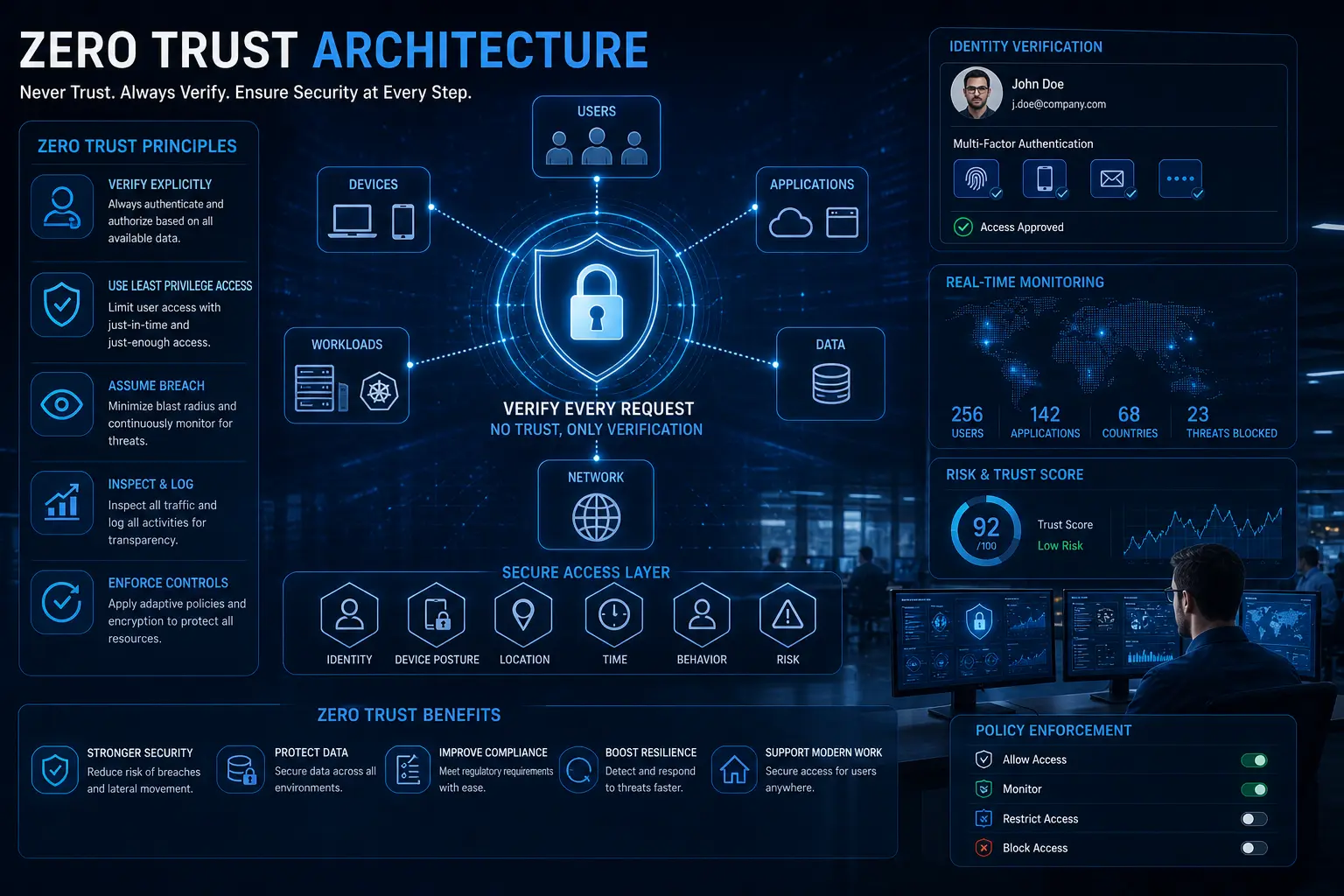
For years, enterprise security operated on a simple assumption: once inside the network, users could be trusted. That model no longer works.
Modern businesses operate in distributed environments remote teams, cloud systems, third-party integrations. The traditional perimeter has effectively disappeared. As a result, attackers no longer need to break through strong defenses; they simply exploit weak internal trust.
This is where the Zero Trust Security Model becomes critical.
Instead of assuming trust, Zero Trust works on a fundamentally different principle: never trust, always verify. Every user, device, and request must be validated before access is granted.
🔐 What is the Zero Trust Security Model?
Zero Trust is not a single product or tool. It is a comprehensive security framework designed to eliminate implicit trust within an organization’s infrastructure.
Under this model:
- No user is trusted by default
- No device is automatically considered secure
- Every access request is verified in real time
This approach significantly reduces the risk of unauthorized access, even if attackers manage to infiltrate the network.
⚙️ Core Principles of Zero Trust
1. Identity Verification
Every access request begins with identity validation. Multi-factor authentication (MFA) is often used to ensure that users are who they claim to be.
Identity is no longer just a username and password it includes device status, location, and behavior patterns.
2. Least Privilege Access
Users are granted only the access they need to perform their tasks nothing more.
This limits the potential damage if an account is compromised. Even if attackers gain access, their reach is restricted.
3. Continuous Monitoring
Zero Trust is not a one-time verification process.
Systems continuously monitor user behavior and network activity. If something unusual is detected such as login attempts from different locations access can be restricted immediately.
4. Micro-Segmentation
Instead of one large network, Zero Trust divides infrastructure into smaller segments.
Each segment requires its own authentication, making it harder for attackers to move laterally within the system.
🚨 Why Traditional Security Models Fail
The old “castle-and-moat” approach focused on securing the perimeter.
Once inside, users had broad access to systems and data. This created a major vulnerability.
In today’s environment:
- Remote work increases attack surfaces
- Cloud systems blur network boundaries
- Insider threats are more difficult to detect
Zero Trust addresses these weaknesses by removing the concept of internal trust altogether.
🏢 Real-World Applications in Enterprises
Large organizations are rapidly adopting Zero Trust frameworks.
Cloud Security
With applications hosted on cloud platforms, traditional firewalls are not enough. Zero Trust ensures secure access regardless of location.
Remote Workforce
Employees working from different locations can securely access systems without compromising security.
Third-Party Access
Vendors and partners often require limited access. Zero Trust ensures they only access specific resources.
📊 Benefits of Zero Trust Architecture
🔒 Stronger Security Posture
By verifying every request, the chances of unauthorized access drop significantly.
📉 Reduced Breach Impact
Even if a breach occurs, limited access prevents widespread damage.
🌐 Flexibility for Modern Work
Supports remote work and cloud-based operations without compromising security.
⚠️ Challenges in Implementation
Despite its advantages, Zero Trust is not easy to implement.
Complexity
Transitioning from traditional systems requires significant changes in infrastructure.
Cost
Advanced tools and monitoring systems can increase initial investment.
User Experience
Frequent authentication can sometimes impact usability if not optimized properly.
🧠 Practical Insight
From a real-world perspective, companies that succeed with Zero Trust don’t implement everything at once.
They start small securing critical systems first and gradually expand the framework.
This phased approach reduces disruption and allows teams to adapt.
🔧 Tools and Technologies Supporting Zero Trust
Zero Trust relies on a combination of tools:
- Identity and Access Management (IAM) systems
- Endpoint security solutions
- Network monitoring tools
- Encryption technologies
👉 Use our Password Generator (Security Tool) to strengthen authentication practices across systems.
👉 Analyze server security with the HTTP Header Checker to ensure proper security configurations.
👉 Verify site protection using the SSL Checker for encrypted communication.
🔮 Future of Zero Trust
As cyber threats evolve, Zero Trust is becoming the standard rather than an option.
Organizations are moving toward identity-driven security models that adapt in real time.
Artificial intelligence and machine learning are also being integrated to detect anomalies faster and improve response times.



Bureau Discourse
Participate in the Analysis
Your contribution is subject to editorial moderation.