
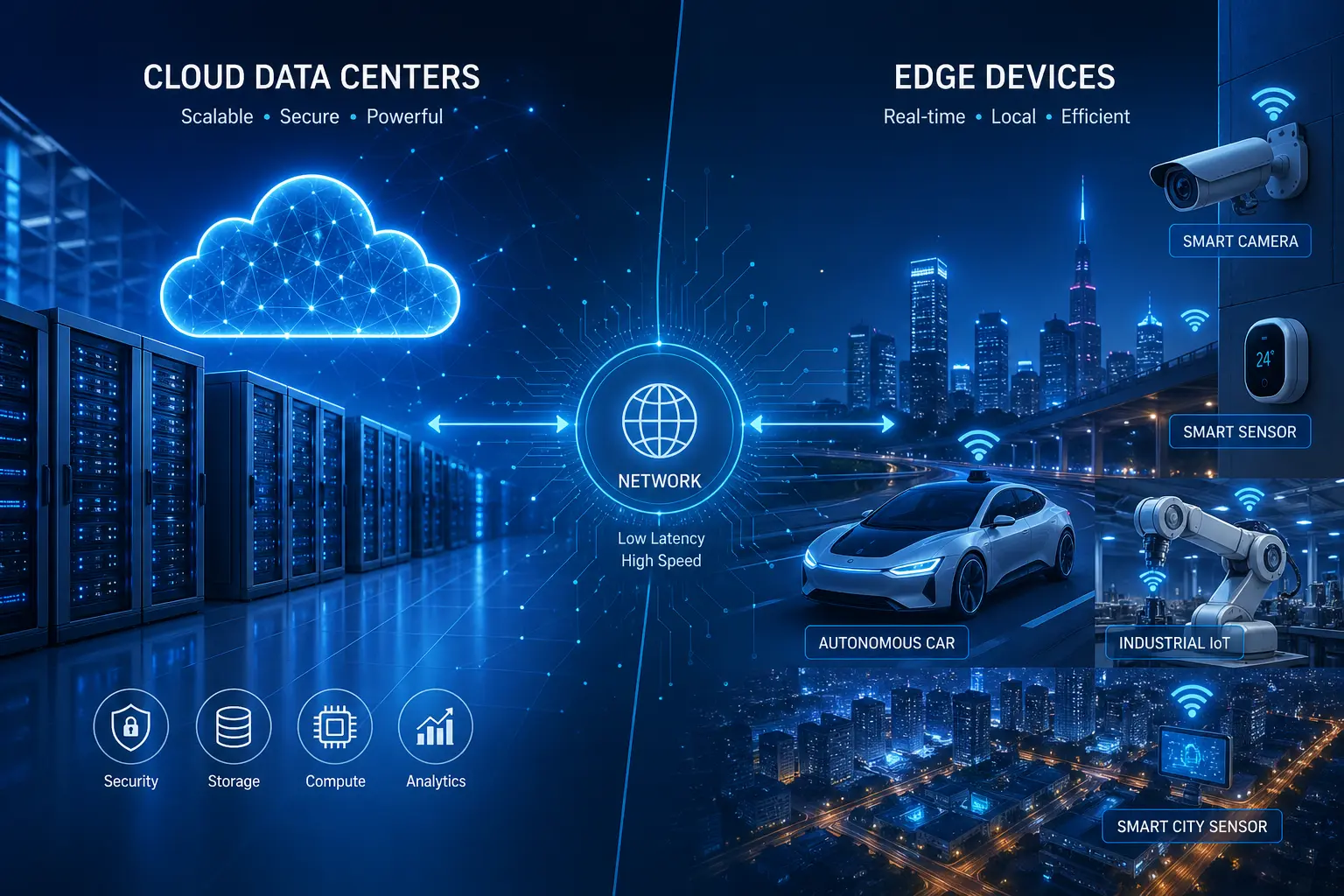
In the last decade, the way digital systems are built and scaled has changed dramatically. Businesses no longer rely on traditional on-premise infrastructure. Instead, they operate in a world powered by distributed computing models, where speed, flexibility, and real-time processing define success.
At the center of this shift are two powerful paradigms: cloud computing and edge computing. While both aim to improve performance and scalability, they approach the problem from entirely different directions. Understanding how they differ and where they complement each other is becoming critical for organizations designing next-generation systems.
🔧 Optimize your content using our Keyword Density Checker to ensure proper keyword balance for better rankings.
🌐 What is Cloud Computing?
Cloud computing refers to the delivery of computing services servers, storage, databases, networking, and software over the internet. Instead of maintaining physical hardware, companies can access resources on demand through providers like AWS, Microsoft Azure, or Google Cloud.
The biggest advantage of cloud infrastructure is its centralization and scalability. Organizations can scale up or down based on demand without investing heavily in hardware. This flexibility has made cloud computing the backbone of modern digital businesses.
From startups launching applications to global enterprises managing massive workloads, cloud computing provides a cost-effective and reliable foundation.
🔍 Want to see how your page appears on Google? Use our SERP Preview Tool to optimize your title and meta description.
⚡ What is Edge Computing?
Edge computing, on the other hand, brings computation closer to the source of data. Instead of sending all data to centralized cloud servers, processing happens at or near the “edge” of the network such as IoT devices, local servers, or embedded systems.
This approach reduces latency and enables real-time decision-making. For example, autonomous vehicles, smart factories, and healthcare monitoring systems cannot afford delays caused by sending data to distant servers.
Edge computing is designed for environments where speed, responsiveness, and local processing are critical.
🔍 Key Differences Between Cloud and Edge Computing
The distinction between these two models lies in how and where data is processed.
Cloud computing operates on centralized data centers, which means data must travel from the user or device to the cloud. This can introduce latency, especially in time-sensitive applications.
Edge computing minimizes this delay by processing data locally. This makes it ideal for scenarios where milliseconds matter.
Another key difference is bandwidth usage. Cloud-based systems often require large volumes of data to be transmitted continuously. Edge computing reduces this load by filtering and processing data locally before sending only relevant information to the cloud.
In terms of scalability, cloud computing has a clear advantage. It allows organizations to expand infrastructure globally with minimal effort. Edge computing, while powerful, requires distributed hardware deployment, which can be more complex to manage.
⚙️ Improve your technical SEO by generating structured data using our Schema Generator.
🚀 Why Businesses Are Moving Toward Hybrid Models
The future is not about choosing between cloud and edge it’s about combining both.
Organizations are increasingly adopting hybrid architectures where edge devices handle real-time processing, and cloud platforms manage storage, analytics, and long-term computation.
For instance, in a smart manufacturing setup, sensors on machines can analyze data locally to detect faults instantly. At the same time, aggregated data is sent to the cloud for deeper analysis and optimization.
This hybrid model ensures both speed and scalability.
📊 Real-World Applications
The impact of these technologies is visible across industries.
In healthcare, wearable devices use edge computing to monitor patient vitals in real time, while cloud platforms store historical data for analysis.
In retail, edge systems enable faster checkout and personalized experiences, while cloud systems manage inventory and customer data.
In autonomous systems, edge computing ensures immediate decision-making, which is critical for safety.
These examples highlight how both technologies work together to create efficient and intelligent systems.
🔐 Security Considerations
Security is a major concern in both cloud and edge environments.
Cloud platforms invest heavily in security infrastructure, offering encryption, identity management, and compliance tools. However, centralization also makes them attractive targets for large-scale attacks.
Edge computing distributes data processing, which reduces the risk of a single point of failure. However, it introduces new challenges, such as securing multiple devices and endpoints.
Organizations must adopt a layered security strategy that covers both environments.
⏱️ Estimate how long your content takes to read using our Reading Time Calculator to improve user engagement.
📈 Performance and Latency
Performance is where edge computing truly shines.
Applications that require real-time processing such as gaming, video streaming, and industrial automation benefit significantly from reduced latency.
🌐 Analyze server response and performance using our HTTP Header Checker tool.
Cloud computing, while slightly slower in these scenarios, excels in handling large-scale data processing and analytics.
The choice depends on the specific requirements of the application.
🔮 Future of Scalable Systems
As digital ecosystems continue to evolve, the demand for faster and more efficient systems will only increase.
Technologies like 5G, IoT, and AI are accelerating the adoption of edge computing. At the same time, cloud platforms are becoming more powerful and accessible.
The future lies in intelligent distribution of workloads, where systems dynamically decide whether to process data at the edge or in the cloud.
This will lead to more resilient, scalable, and efficient infrastructures.



Bureau Discourse
Participate in the Analysis
Your contribution is subject to editorial moderation.