
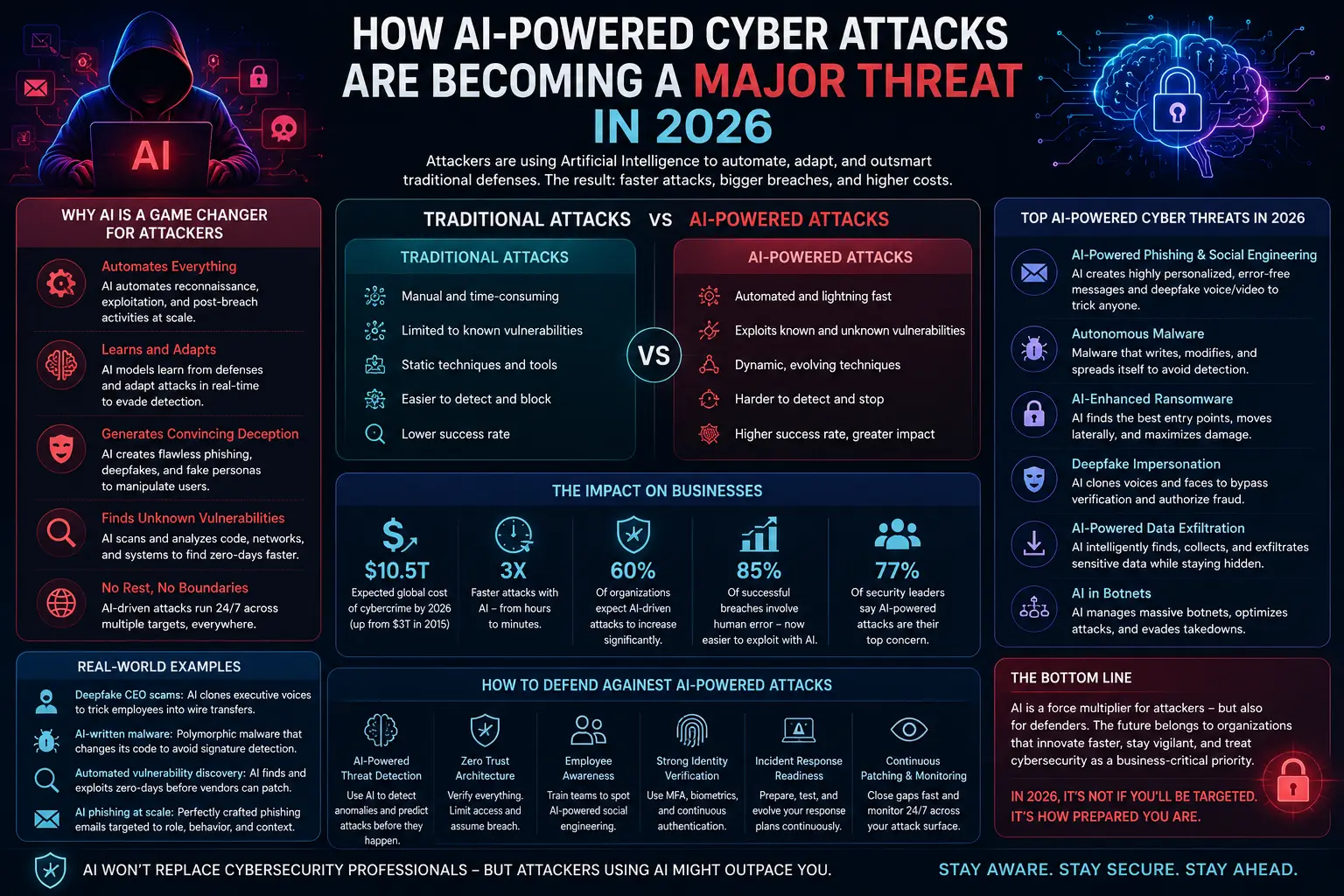
Artificial Intelligence is transforming industries across the world, but cybersecurity experts are increasingly warning about a darker side of this technology. In 2026, AI is not only helping businesses improve automation and productivity — it is also making cyber attacks more sophisticated, scalable, and difficult to detect.
Cybersecurity threats have existed for years, but the rise of AI-powered attack systems is changing how hackers operate. Earlier cyber attacks often depended heavily on manual effort, technical skill, and time-consuming processes. Today, AI tools are helping attackers automate many parts of digital crime.
This shift is becoming a serious concern for businesses, governments, financial institutions, healthcare systems, and even individual internet users.
What Are AI-Powered Cyber Attacks?
AI-powered cyber attacks are digital attacks that use artificial intelligence to automate hacking techniques, phishing scams, malware generation, and system exploitation. In 2026, businesses are facing more advanced cyber threats because attackers are increasingly using AI tools to improve speed, scale, and attack accuracy.
Bureau Verification Tools
As companies continue digitizing operations rapidly, the attack surface for cybercriminals is expanding at the same time.
Why Cybersecurity Threats Are Growing Rapidly
Businesses today depend heavily on digital systems.
Companies now store large amounts of:
- Customer information
- Financial records
- Internal communication
- Operational data
- Cloud-based systems
- Online payment infrastructure
This creates attractive targets for cybercriminals.
At the same time, AI technology is making attack methods faster and more advanced than traditional hacking techniques.
Cybersecurity experts are increasingly warning that businesses are entering a new era where automated attacks may become far more common.
AI Is Making Phishing Attacks More Dangerous
Phishing attacks remain one of the most common cybersecurity threats globally.
However, AI is making phishing campaigns significantly more convincing.
Scam Emails
Earlier phishing emails often contained obvious grammar mistakes or suspicious formatting.
Modern AI systems can now generate highly realistic messages that sound professional and personalized.
Attackers are using AI to create:
- Fake business emails
- Financial scams
- Customer support impersonations
- Login credential requests
- Executive impersonation messages
This makes it harder for users to identify fraudulent communication.
Personalized Social Engineering
AI tools can analyze publicly available information from social media, websites, and online platforms to create highly targeted scam attempts.
These attacks feel more believable because they often reference real names, companies, or activities.
Malware Is Becoming Smarter
Cybersecurity researchers are also warning about the growth of AI-assisted malware systems.
Adaptive Malware Behavior
Some AI-driven malware systems can modify behavior dynamically to avoid detection from traditional security software.
This creates challenges for older cybersecurity systems that rely mainly on fixed threat signatures.
Automated Vulnerability Discovery
AI tools are increasingly capable of scanning systems rapidly for weaknesses and potential vulnerabilities.
This allows attackers to identify targets faster than before.
Deepfake Technology Is Creating New Security Risks
One of the fastest-growing cybersecurity concerns in 2026 is deepfake technology.
voice and video manipulation systems are becoming increasingly realistic.
Fake Executive Calls and Videos
Cybercriminals are using voices and videos to impersonate company executives, financial officers, or trusted individuals.
Some businesses have already faced fraud attempts involving fake voice calls requesting financial transfers or sensitive information.
Identity Manipulation
Deepfake systems are also creating concerns around digital identity verification and online trust.
As these technologies improve, businesses may face growing challenges related to authentication and fraud prevention.
Businesses Are Becoming More Vulnerable Through Automation
Modern businesses are increasingly connected through cloud systems, APIs, remote work infrastructure, and automation platforms.
While this improves efficiency, it also creates more entry points for cyber attacks.
Remote Work Security Challenges
The growth of remote work has increased cybersecurity pressure significantly.
Employees now access company systems from multiple devices and networks, increasing exposure to security risks.
Third-Party System Risks
Businesses using multiple software platforms and integrations sometimes unknowingly create additional vulnerabilities through connected systems.
Ransomware Attacks Continue Growing
Ransomware remains one of the biggest cybersecurity threats facing organizations worldwide.
Attackers increasingly use AI tools to automate targeting, system analysis, and attack execution.
Businesses Are Major Targets
Healthcare organizations, financial companies, educational institutions, and government systems remain common ransomware targets because downtime creates high pressure to restore operations quickly.
Data Theft Is Becoming More Common
Modern ransomware attacks often involve both encryption and data theft.
Attackers now threaten businesses with public data leaks in addition to operational disruption.
Cybersecurity Is Becoming a Business Priority
Earlier, many businesses treated cybersecurity mainly as a technical issue handled by IT departments.
In 2026, cybersecurity is becoming a core business strategy issue.
Companies are realizing that security breaches can damage:
- Reputation
- Customer trust
- Financial stability
- Operations
- Legal compliance
This is pushing organizations to invest more heavily in digital security systems and employee awareness.
AI Is Also Helping Cybersecurity Defenses
Interestingly, AI is not only helping attackers.
Cybersecurity companies are also using AI systems to improve defense mechanisms.
AI Threat Detection
Modern security platforms use AI to detect unusual activity patterns, suspicious behavior, and potential threats faster than traditional systems.
Faster Incident Response
AI-powered systems help security teams analyze large amounts of security data more efficiently during cyber incidents.
This improves response speed and reduces damage risk.
Human Error Still Causes Many Security Breaches
Despite advanced technology, many cyber attacks still succeed because of human mistakes.
Common problems include:
- Weak passwords
- Clicking suspicious links
- Poor security practices
- Lack of employee awareness
- Misconfigured systems
Businesses are increasingly investing in cybersecurity training alongside technical protection.
The Future of Cybersecurity in the AI Era
Industry experts believe cybersecurity will become even more complex over the next few years as AI systems continue evolving.
Future security trends are expected to include:
- AI-driven threat detection
- Zero-trust security models
- Advanced identity verification
- Behavioral cybersecurity analysis
- AI-assisted fraud prevention
- Automated incident response systems
At the same time, attackers are also expected to continue improving AI-powered attack techniques.
Final Thoughts
AI-powered cyber attacks are becoming one of the biggest digital threats facing businesses in 2026.
As artificial intelligence becomes more advanced, cybercriminals are finding new ways to automate scams, phishing campaigns, malware systems, and identity manipulation techniques.
Businesses are now entering a cybersecurity environment where traditional security approaches alone may no longer be enough.
The companies most prepared for the future will likely be the ones combining advanced security technology, employee awareness, strong digital practices, and continuous cybersecurity adaptation.
In a rapidly evolving digital world, cybersecurity is no longer optional protection. It is becoming a fundamental part of business survival itself.
FAQ
What are AI-powered cyber attacks?
AI-powered cyber attacks use artificial intelligence to automate hacking, phishing, malware creation, and digital fraud techniques.
Why are AI cyber attacks becoming dangerous?
AI makes cyber attacks faster, more scalable, personalized, and harder to detect compared to traditional attacks.
What industries face the biggest cybersecurity risks?
Healthcare, finance, government, education, and digital businesses are among the biggest cyber attack targets.
Can AI improve cybersecurity too?
Yes, AI is also helping cybersecurity companies detect threats, monitor suspicious activity, and improve incident response.
How can businesses protect themselves from cyber attacks?
Businesses can improve cybersecurity through employee training, strong passwords, updated systems, AI-powered security tools, and proper security policies.


Discussion & Feedback
Join The Discourse
Comments are reviewed for technical quality.