
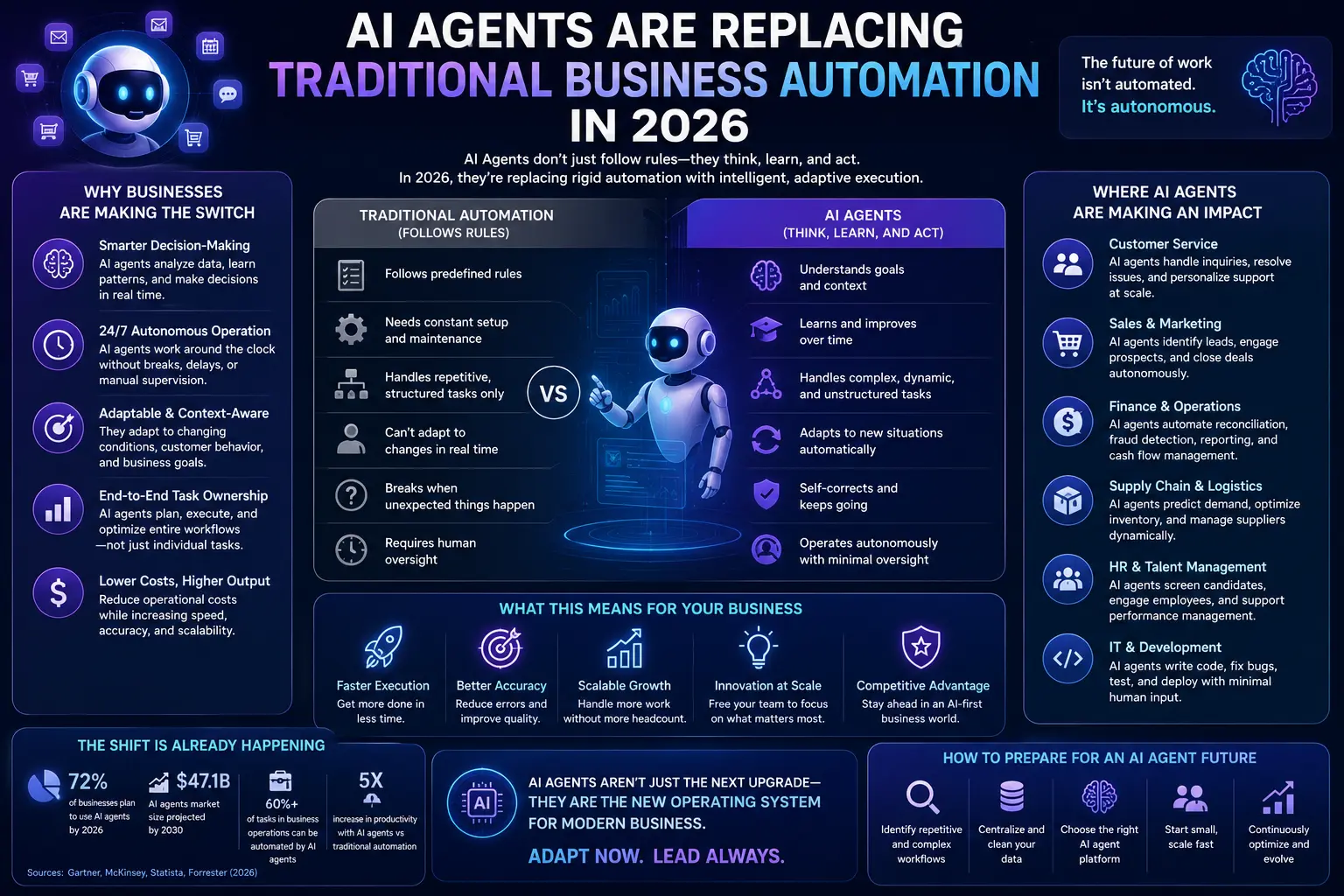
Business automation is changing rapidly, and one of the biggest shifts happening in 2026 is the rise of AI agents. What started as simple automation tools handling repetitive tasks is now evolving into intelligent systems capable of making decisions, managing workflows, and performing complex operations with minimal human involvement.
Over the last few years, businesses have relied heavily on automation platforms for tasks like email marketing, scheduling, reporting, customer support, and CRM management. But traditional automation systems usually depend on fixed instructions and predefined workflows.
AI agents are changing that completely.
Instead of only following static commands, these systems can analyze situations, process information, adapt to changing conditions, and perform multiple connected tasks more independently.
Bureau Verification Tools
What Are AI Agents in Business Automation?
AI agents are intelligent software systems capable of performing business tasks independently using artificial intelligence. Unlike traditional automation tools that follow fixed rules, AI agents can analyze information, make decisions, handle workflows, and adapt to changing situations in real time.
This is why AI agents are becoming one of the most discussed topics in the technology and business world right now.
Why Businesses Are Moving Beyond Traditional Automation
Traditional automation helped businesses save time by reducing repetitive manual work. But companies eventually started facing limitations.
Older automation systems usually require:
- Fixed workflows
- Manual setup
- Rule-based triggers
- Constant monitoring
- Human intervention for unexpected situations
As business operations became more dynamic, companies started looking for systems capable of handling more flexible tasks.
AI agents are filling that gap.
Businesses now want automation systems that can think, analyze, and adapt rather than simply repeat predefined actions.
What Makes AI Agents Different
The biggest difference between traditional automation and AI agents is decision-making capability.
Traditional Automation Follows Instructions
Older automation systems only perform actions exactly as programmed.
For example:
- Sending scheduled emails
- Updating spreadsheets
- Triggering notifications
- Moving data between platforms
These systems work efficiently for repetitive operations but struggle when situations change unexpectedly.
AI Agents Analyze and Respond
AI agents can process information, understand context, and choose actions based on changing conditions.
This allows them to handle more advanced workflows involving:
- Customer interaction
- Research tasks
- Data analysis
- Lead qualification
- Scheduling decisions
- Workflow coordination
Instead of simply executing commands, AI agents are increasingly acting like digital assistants capable of handling multi-step business operations.
Businesses Are Using AI Agents Across Multiple Industries
AI agents are quickly expanding beyond experimental use cases.
Many companies are already testing or deploying AI-driven systems across daily business operations.
Customer Support Automation
Businesses are using AI agents to handle customer communication more naturally compared to older chatbot systems.
Modern AI support agents can:
- Understand customer intent
- Respond conversationally
- Access business information
- Escalate issues when needed
- Learn from interactions
This creates smoother customer experiences compared to scripted automation.
AI Sales Assistants
Sales teams are using AI agents for:
- Lead qualification
- Customer follow-ups
- CRM management
- Meeting scheduling
- Prospect research
This helps businesses reduce repetitive sales workload while improving response speed.
Research and Data Collection
Some companies are using AI agents to gather information, summarize reports, analyze trends, and organize large amounts of data automatically.
This is becoming especially useful for digital businesses and research-heavy industries.
AI Agents Are Supporting Small Businesses Too
One reason AI agents are growing quickly is accessibility.
Earlier, advanced automation systems were mainly available to large enterprises. In 2026, even startups and small businesses are experimenting with AI-powered workflows.
Small businesses are using AI agents for:
- Social media assistance
- Content planning
- Email automation
- Appointment management
- Customer communication
- Workflow organization
This allows smaller teams to handle larger workloads more efficiently.
The Rise of Autonomous Workflows
One major trend businesses are exploring is autonomous workflows.
Instead of manually controlling every automation step, businesses are testing systems where AI agents manage multiple connected tasks independently.
For example, an AI agent may:
- Receive a customer inquiry
- Analyze the request
- Access internal data
- Schedule follow-ups
- Generate summaries
- Notify relevant team members
without requiring continuous manual input.
This level of workflow automation is becoming increasingly attractive for businesses focused on productivity.
AI Agents and Human Workers
The rise of AI agents has also created debate around jobs and workforce changes.
Some businesses see AI agents as tools for replacing repetitive administrative work, while others view them as productivity support systems for employees.
In reality, most companies are currently using AI agents to assist teams rather than completely replace human workers.
Human Oversight Still Matters
AI systems still struggle with:
- Emotional understanding
- Complex judgment
- Creative strategy
- Relationship building
- Ethical decisions
Because of this, businesses are learning that AI agents work best when combined with human supervision and decision-making.
Security and Privacy Concerns Are Growing
As AI agents become more capable, businesses are also becoming more cautious about security.
AI systems often process sensitive business information, customer data, and operational workflows.
This creates concerns related to:
- Data privacy
- Unauthorized access
- errors
- Security vulnerabilities
- Compliance risks
Businesses adopting AI agents are increasingly focusing on cybersecurity and controlled implementation strategies.
The Competition Around AI Agents Is Intensifying
Technology companies are investing heavily in AI agent development right now.
Businesses are competing to build systems capable of:
- Multi-step reasoning
- Workflow automation
- Task delegation
- Real-time decision-making
- Business integration
Industry experts believe AI agents may become one of the biggest software trends over the next few years.
The Future of AI Agents in Business
The role of AI agents is expected to grow significantly across industries.
Future AI systems may become capable of handling more advanced business functions involving:
- Customer relationship management
- Project coordination
- Internal operations
- Predictive business analysis
- Intelligent reporting
- Cross-platform workflow execution
However, businesses are also realizing that successful automation still depends heavily on human planning, oversight, and strategic direction.
Final Thoughts
AI agents are transforming business automation by moving beyond simple rule-based systems toward more intelligent workflow management.
Businesses are increasingly using AI agents to improve productivity, reduce repetitive tasks, and support faster operations across customer service, sales, research, and administration.
At the same time, companies are learning that automation alone is not enough. Human creativity, leadership, and strategic thinking still remain essential for long-term business success.
The businesses likely to benefit most from AI agents are not necessarily the ones automating everything blindly, but the ones combining intelligent systems with smart human decision-making.
FAQ
What are AI agents?
AI agents are intelligent systems that can analyze information, make decisions, and perform tasks independently using artificial intelligence.
How are AI agents different from traditional automation?
Traditional automation follows fixed rules, while AI agents can adapt, analyze situations, and handle more flexible workflows.
What industries are using AI agents?
Businesses in customer support, sales, healthcare, marketing, finance, and digital services are increasingly using AI agents.
Can AI agents replace employees completely?
Most businesses currently use AI agents to support employees and automate repetitive tasks rather than fully replace human workers.
Why are AI agents becoming popular in 2026?
Businesses are adopting AI agents because they improve productivity, automate complex workflows, and reduce manual operational workload.


Discussion & Feedback
Join The Discourse
Comments are reviewed for technical quality.