
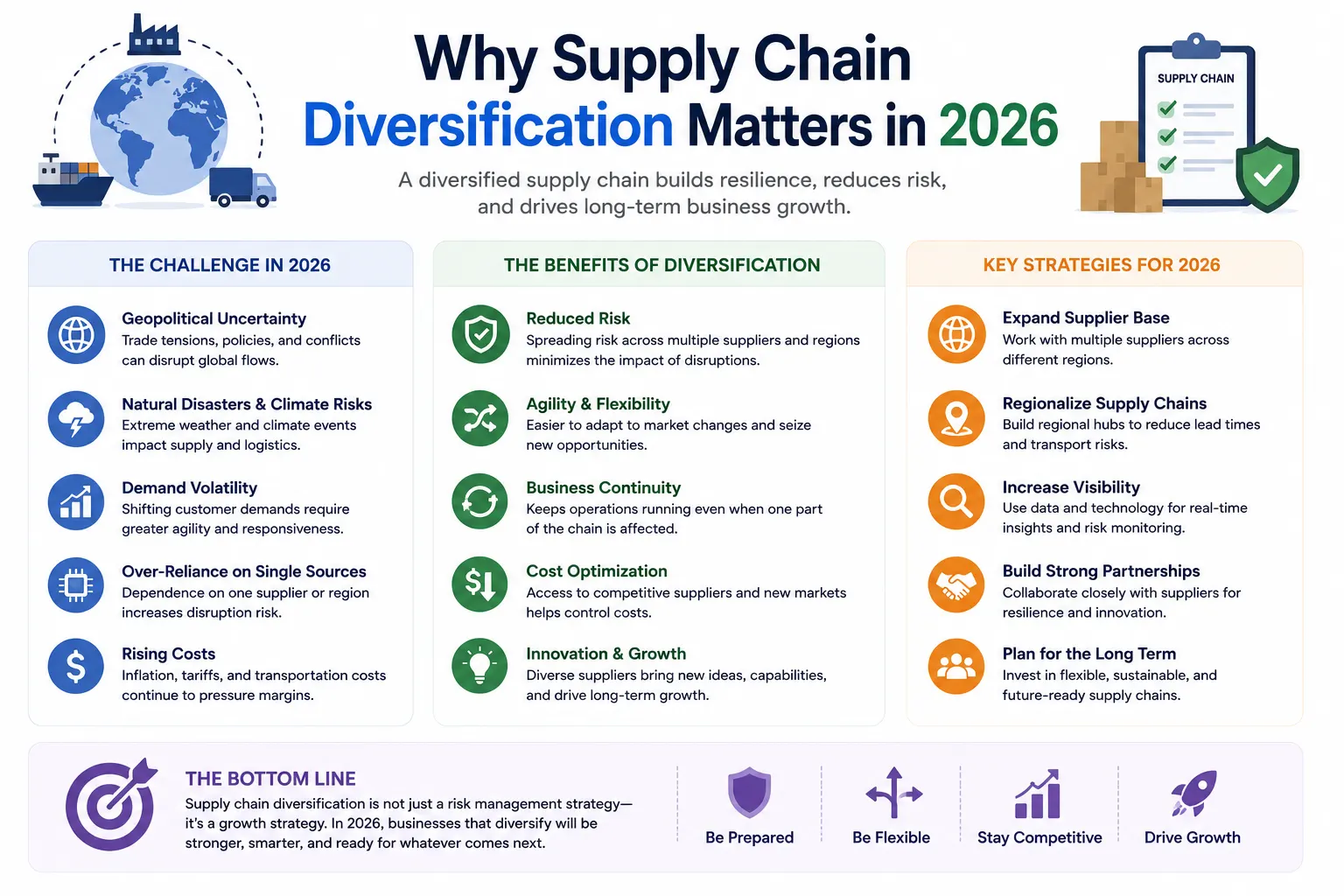
Global business operations are changing rapidly, and one of the biggest strategic shifts happening in 2026 is supply chain diversification. Companies worldwide are rethinking how products, materials, and operational resources move across international markets.
Over the last few years, businesses experienced major disruptions caused by shipping delays, geopolitical tensions, manufacturing slowdowns, labor shortages, and rising logistics costs. These problems exposed how vulnerable many companies had become by depending too heavily on limited supply networks.
As a result, businesses are now focusing more seriously on resilience and flexibility rather than only cost optimization.
Supply chain diversification is becoming a central business strategy across industries ranging from manufacturing and technology to retail and healthcare.
Bureau Verification Tools
Why Businesses Are Changing Supply Chain Strategies
For many years, businesses focused mainly on efficiency and lower production costs.
Companies often relied heavily on:
- Single-country manufacturing
- Centralized production systems
- Limited supplier networks
- Just-in-time inventory models
This approach reduced operational costs but also increased vulnerability when disruptions occurred.
Recent global challenges showed businesses that efficiency alone is not enough without operational stability.
Businesses Are Trying to Reduce Dependency Risks
One major lesson companies learned is the danger of relying too heavily on one supplier, one country, or one logistics route.
Geopolitical Tensions Are Affecting Trade
Political conflicts and international trade tensions are increasingly influencing global supply chains.
Businesses are becoming more cautious about concentrating operations in regions where sudden disruptions could impact production or shipping.
Manufacturing Delays Created Global Problems
Industries such as electronics, automotive, healthcare, and retail faced shortages when manufacturing disruptions slowed production worldwide.
This forced many businesses to rethink sourcing strategies.
Supply Chain Resilience Is Becoming More Important Than Low Cost
Earlier, businesses often prioritized the cheapest manufacturing option available.
In 2026, many companies are balancing cost with resilience and long-term operational stability.
Businesses Want More Flexibility
Companies are now expanding supplier networks across multiple regions to reduce dependency on single sources.
This helps businesses continue operations even if disruptions affect one part of the supply chain.
Inventory Strategies Are Changing
Some companies are moving away from extremely lean inventory models and maintaining more strategic stock levels to improve stability.
Technology Is Playing a Bigger Role in Supply Chains
Digital transformation is becoming increasingly important in supply chain management.
Businesses are using technology to improve visibility, forecasting, and operational control.
AI and Data Analytics
AI-powered systems are helping companies analyze:
- Demand forecasting
- Inventory planning
- Shipping patterns
- Supply chain risks
- Logistics efficiency
This allows businesses to respond faster when disruptions happen.
Real-Time Tracking Systems
Modern supply chain platforms now provide real-time shipment tracking and operational monitoring across global logistics networks.
Businesses Are Expanding Regional Manufacturing
Another major trend in 2026 is regional diversification.
Instead of depending entirely on distant manufacturing hubs, some companies are moving parts of production closer to target markets.
Nearshoring and Regional Production
Businesses are increasingly exploring:
- Regional manufacturing hubs
- Nearshoring strategies
- Multi-country sourcing
- Distributed production systems
This can improve delivery speed while reducing logistical uncertainty.
Logistics Costs Continue Affecting Global Trade
Transportation and shipping costs remain major concerns for businesses operating internationally.
Fuel and Shipping Volatility
Energy price fluctuations and global shipping pressure continue influencing operational costs for many industries.
Businesses are becoming more careful about logistics planning and transportation efficiency.
Port Congestion and Delays
Shipping delays and port congestion still create challenges for companies relying heavily on international trade networks.
Supply Chain Security Is Becoming a Priority
Businesses are also paying closer attention to supply chain security risks.
Cybersecurity threats, counterfeit products, and operational vulnerabilities are becoming larger concerns in globally connected systems.
Digital Supply Chains Create New Risks
As supply chains become more digitized, businesses are also facing:
- Data security challenges
- System vulnerabilities
- Operational cyber risks
- Third-party security concerns
This is pushing companies to strengthen both physical and digital supply chain protection.
Sustainability Is Influencing Supply Chain Decisions
Environmental concerns are also affecting global supply chain strategy.
Consumers and investors are increasingly paying attention to sustainability and ethical sourcing practices.
Businesses Are Reviewing Environmental Impact
Companies are focusing more on:
- Sustainable sourcing
- Carbon footprint reduction
- Cleaner logistics systems
- Energy-efficient operations
This is influencing long-term supply chain planning decisions.
Organizations such as World Economic Forum and World Trade Organization (WTO) regularly discuss global trade and supply chain trends.
Small Businesses Are Also Adapting
Supply chain diversification is no longer only a concern for large multinational corporations.
Even smaller businesses are becoming more cautious about supplier dependency and inventory management.
Many small companies are:
- Expanding vendor options
- Building backup suppliers
- Improving inventory tracking
- Using digital logistics tools
This helps reduce operational risk during unexpected disruptions.
The Future of Global Supply Chains
Industry experts believe supply chains will continue evolving toward more flexible and technology-driven systems over the next decade.
Future trends are expected to include:
- AI-powered logistics systems
- Smart warehouses
- Automated inventory management
- Regionalized manufacturing
- Predictive supply chain analytics
- Sustainable logistics infrastructure
Businesses are increasingly prioritizing resilience alongside efficiency.
Final Thoughts
Supply chain diversification is becoming one of the most important global business strategies in 2026.
Recent disruptions showed companies that depending too heavily on limited suppliers or centralized operations creates major long-term risk.
Businesses are now focusing more on resilience, flexibility, technology integration, and operational stability while preparing for uncertain global conditions.
The companies likely to succeed long term are not simply the ones reducing costs aggressively, but the ones building stronger and more adaptable operational systems capable of handling future disruptions more effectively.
Sources & References
FAQ
What is supply chain diversification?
Supply chain diversification means using multiple suppliers, regions, and logistics networks to reduce operational risk.
Why are businesses diversifying supply chains?
Businesses are diversifying supply chains to improve resilience, reduce dependency risks, and avoid disruptions.
What industries are most affected by supply chain disruptions?
Manufacturing, automotive, healthcare, retail, and technology industries are heavily affected by supply chain issues.
How is technology improving supply chains?
AI, analytics, and real-time tracking systems are helping businesses improve forecasting, logistics, and operational visibility.
What is the future of supply chain strategy?
Experts expect supply chains to become more flexible, technology-driven, sustainable, and regionally diversified in the coming years.


Discussion & Feedback
Join The Discourse
Comments are reviewed for technical quality.