
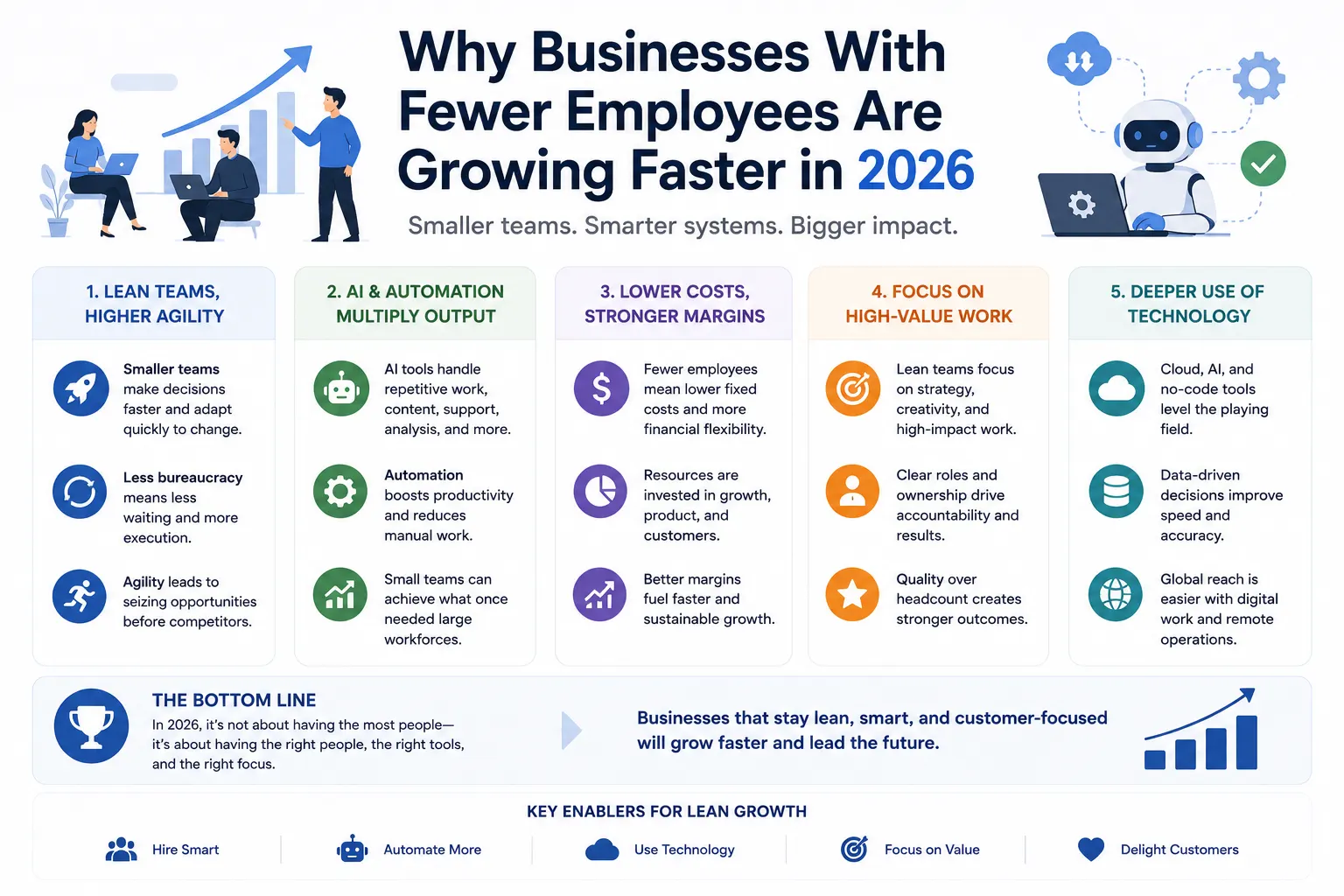
For decades, large teams were often seen as a sign of business strength and success. Companies expanded offices, hired aggressively, and built large workforces to increase operations and scale faster.
But in 2026, something very different is happening.
A growing number of businesses with relatively small teams are now competing successfully against much larger organizations. In some industries, smaller companies are even growing faster while operating with significantly fewer employees.
This shift is changing how people think about business growth, productivity, and operational efficiency.
Bureau Verification Tools
Why Are Businesses With Smaller Teams Growing Faster?
Businesses with smaller teams are growing faster in 2026 because they use automation, AI systems, lean operations, and digital workflows to improve efficiency while reducing operational complexity and overhead costs.
The reason behind this change is not simply cost-cutting. It is largely connected to technology, automation, digital workflows, and smarter operational systems.
Modern businesses are discovering that growth no longer depends only on workforce size. It increasingly depends on how efficiently teams operate.
Technology Has Changed Business Operations
One major reason smaller teams are scaling faster is technology.
Earlier, businesses needed large staff for tasks such as:
- Customer support
- Marketing operations
- Data entry
- Scheduling
- Reporting
- Communication management
- Content publishing
Today many of those operations can be handled through automation tools and AI-powered systems.
This allows businesses to operate more efficiently with smaller teams.
AI Automation Is Reducing Repetitive Work
Artificial Intelligence is becoming one of the biggest reasons businesses are restructuring operations.
Companies are using AI systems for:
- Customer service automation
- Workflow management
- Content assistance
- Analytics reporting
- Scheduling
- CRM management
- Data organization
Instead of hiring large administrative teams, businesses are increasingly building technology-supported workflows.
Organizations such as McKinsey & Company continue discussing how automation and AI are changing workforce productivity globally.
Lean Businesses Are Becoming More Agile
Smaller teams often move faster because decision-making becomes simpler.
Large organizations sometimes struggle with:
- Slow approvals
- Complex management layers
- Internal coordination delays
- Communication bottlenecks
Lean businesses can often adapt more quickly because fewer layers exist between planning and execution.
Faster Adaptation Matters in 2026
Markets are changing rapidly.
Customer behavior, digital trends, AI technology, and online competition continue evolving quickly. Businesses that adapt faster often gain competitive advantages.
Smaller teams supported by strong systems can usually respond more efficiently to market changes.
Businesses Are Focusing More on Efficiency Than Size
One major trend in modern business strategy is operational efficiency.
Earlier, aggressive expansion and rapid hiring were often viewed positively. Today many companies are becoming more cautious about building oversized operational structures.
Rising Operational Costs Are Affecting Hiring
Businesses now face higher costs related to:
- Salaries
- Office infrastructure
- Software systems
- Employee management
- Training
- Administration
Because of this, companies are trying to improve productivity without unnecessarily increasing workforce size.
Remote Work Has Changed Team Structures
Remote and hybrid work models also influenced this shift.
Businesses discovered they could operate effectively without large centralized office environments.
This allowed companies to:
- Hire globally
- Reduce office costs
- Build flexible teams
- Improve operational efficiency
As digital collaboration tools improved, physical team size became less important for many industries.
Specialized Teams Are Replacing Large Departments
Modern businesses increasingly prefer highly skilled smaller teams over large general operational structures.
Multi-Skilled Employees Are Becoming More Valuable
Companies now value employees capable of handling multiple responsibilities efficiently.
This includes areas such as:
- Digital marketing
- Automation workflows
- AI-assisted operations
- Content systems
- Customer engagement
Businesses with adaptable and technology-aware teams often scale faster.
Automation Is Helping Startups Compete With Bigger Companies
Earlier, startups faced major disadvantages compared to large enterprises because of limited manpower.
In 2026, automation tools are helping smaller businesses compete more effectively.
Startups now have access to:
- AI assistants
- Cloud systems
- Workflow automation
- Advanced analytics
- CRM platforms
- Digital marketing tools
This allows small businesses to operate at scale with limited teams.
Businesses Are Becoming More Careful About Expansion
Many companies learned difficult lessons from rapid over-expansion in previous years.
Aggressive hiring without sustainable growth often created:
- Financial pressure
- Management complexity
- Reduced efficiency
- Internal communication problems
As a result, businesses are becoming more disciplined about scaling operations.
Productivity Is Becoming More Important Than Headcount
Modern business success is increasingly measured by efficiency and output rather than workforce size alone.
Investors and business leaders are paying more attention to:
- Operational productivity
- Profitability
- Workflow optimization
- Technology integration
- Scalability
This is changing how businesses structure teams and operations.
Customer Expectations Are Also Changing
Consumers now care more about service quality, speed, and experience rather than company size.
Small businesses with efficient digital systems can often deliver faster and more personalized experiences compared to larger companies with slower internal processes.
This creates opportunities for lean businesses to compete effectively.
AI and Automation Will Continue Reshaping Work
Industry experts believe AI and automation will continue changing workforce structures over the next decade.
Future businesses may rely more heavily on:
- AI-driven operations
- Digital collaboration systems
- Autonomous workflows
- Smaller specialized teams
- Remote operational models
However, human creativity, leadership, strategy, and relationship management will still remain essential.
Challenges Smaller Teams Still Face
Despite advantages, smaller businesses also face challenges.
Burnout Risks
Lean teams can experience heavy workload pressure if systems and responsibilities are not managed properly.
Dependence on Key Employees
Smaller organizations may become vulnerable if critical team members leave unexpectedly.
Scaling Complexity
As businesses grow, maintaining efficiency while expanding operations can become difficult.
The Future of Lean Business Operations
Many experts believe the future of business growth will focus more on intelligent operations rather than simply increasing workforce size.
Companies that combine:
- Automation
- Skilled teams
- Efficient systems
- Strong leadership
- Technology integration
are likely to scale more successfully in modern markets.
Organizations like Harvard Business Review and World Economic Forum regularly discuss how technology is reshaping workforce and business structures globally.
Final Thoughts
Businesses with fewer employees are growing faster in 2026 because technology is changing how companies operate.
Automation, AI systems, digital workflows, and lean operational models are allowing smaller teams to compete more efficiently while reducing unnecessary complexity.
The future of business growth is no longer only about building the largest workforce possible. It is increasingly about building smarter systems, adaptable teams, and efficient operations capable of scaling sustainably.
The businesses likely to succeed long term are not necessarily the ones with the most employees, but the ones using technology and human talent most effectively together.
Sources & References
FAQ
Why are smaller businesses growing faster in 2026?
Smaller businesses are using automation, AI tools, and lean operations to improve efficiency and reduce overhead costs.
How is AI helping small teams?
AI helps automate repetitive tasks such as customer support, reporting, scheduling, and workflow management.
Are lean businesses more efficient?
Lean businesses often adapt faster because they have fewer management layers and simpler operational structures.
Does remote work affect business growth?
Yes, remote work allows businesses to reduce infrastructure costs and build more flexible operational models.
Will AI replace large teams completely?
AI can automate many tasks, but businesses still depend on human creativity, leadership, and strategic decision-making.

Discussion & Feedback
Join The Discourse
Comments are reviewed for technical quality.