
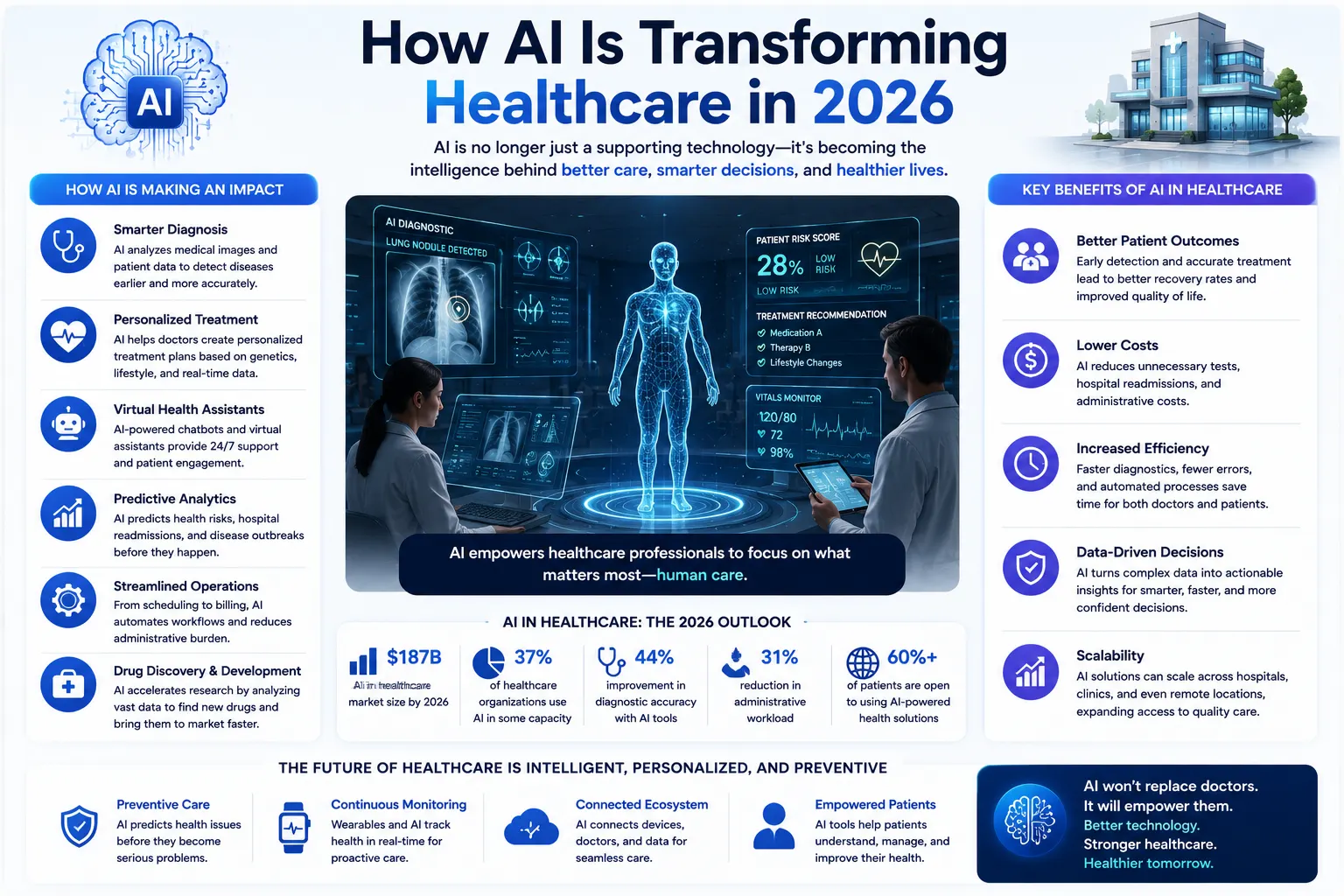
Artificial Intelligence is rapidly becoming one of the most important technologies shaping the healthcare industry. What once sounded like futuristic innovation is now being used in hospitals, clinics, laboratories, healthcare startups, and medical research centers across the world.
In 2026, AI is no longer limited to experimental healthcare projects. Medical organizations are increasingly using intelligent systems to improve diagnostics, patient monitoring, hospital management, research processes, and healthcare accessibility.
The healthcare industry has always faced challenges related to rising patient numbers, staff shortages, operational pressure, and increasing treatment costs. AI is now helping healthcare providers manage some of those problems more efficiently.
How Is AI Transforming Healthcare in 2026?
AI is transforming healthcare in 2026 by improving medical diagnostics, automating hospital operations, supporting doctors with data analysis, enhancing patient monitoring, and accelerating medical research through intelligent healthcare systems.
Bureau Verification Tools
At the same time, the role of technology in healthcare is expanding faster because patients now expect quicker services, digital accessibility, and more personalized care experiences.
Why Healthcare Is Adopting AI So Quickly
Several factors are driving rapid AI adoption in healthcare.
Hospitals and medical organizations are dealing with:
- Growing patient demand
- Increasing healthcare costs
- Staff workload pressure
- Large amounts of medical data
- Demand for faster diagnostics
- Operational inefficiencies
AI systems are helping healthcare providers process information faster while improving efficiency across multiple areas.
Another major reason AI is growing rapidly is data.
Modern healthcare generates enormous amounts of information through medical records, scans, reports, wearable devices, and monitoring systems. AI can analyze this data much faster than traditional manual methods.
AI Is Improving Medical Diagnostics
One of the biggest areas where AI is transforming healthcare is diagnostics.
AI systems are increasingly being used to assist doctors in identifying medical conditions through imaging, pattern recognition, and predictive analysis.
AI in Medical Imaging
Hospitals are using AI-powered systems to analyze:
- X-rays
- MRI scans
- CT scans
- Ultrasound reports
- Pathology images
These systems help doctors detect abnormalities faster and sometimes identify patterns that may be difficult to notice manually.
AI is not replacing doctors, but it is becoming a strong support tool for improving diagnostic speed and accuracy.
Faster Disease Detection
Healthcare providers are also using AI to identify potential health risks earlier.
Some AI systems can analyze patient data and predict the possibility of diseases before symptoms become severe.
This is especially important for conditions where early diagnosis significantly improves treatment outcomes.
AI-Powered Patient Monitoring Is Growing
Remote patient monitoring has become much more important over the last few years.
Healthcare providers are increasingly using AI systems alongside wearable devices and digital monitoring tools.
Wearable Health Technology
Smartwatches and health tracking devices now monitor:
- Heart rate
- Sleep patterns
- Blood oxygen levels
- Physical activity
- Stress indicators
AI systems analyze this information and help identify unusual patterns that may require medical attention.
Remote Healthcare Support
Patients no longer always need to visit hospitals physically for basic monitoring and consultations.
AI-supported telemedicine systems are helping doctors manage patients remotely more efficiently.
Hospitals Are Using AI to Improve Operations
Healthcare organizations are also implementing AI for operational efficiency.
Hospital systems generate complex workflows involving scheduling, patient records, resource management, and staff coordination.
AI is helping automate many repetitive administrative tasks.
Smart Scheduling Systems
Hospitals are using AI to improve appointment scheduling, reduce waiting times, and manage patient flow more efficiently.
Medical Record Management
AI systems can organize and process large amounts of patient information quickly, helping healthcare professionals access important data faster.
Workflow Automation
Healthcare providers are automating:
- Billing processes
- Documentation tasks
- Appointment reminders
- Patient communication
- Administrative reporting
This helps reduce workload pressure on medical staff.
AI Is Accelerating Medical Research
Medical research is another area seeing major transformation through AI technology.
Drug development and clinical research traditionally require enormous amounts of time and data analysis.
AI is helping researchers process medical information faster and identify patterns more efficiently.
Faster Drug Discovery
Researchers are using AI systems to analyze biological data and identify potential drug candidates more quickly than traditional methods.
This is becoming increasingly important for biotechnology and pharmaceutical industries.
Disease Pattern Analysis
AI models are helping scientists study disease behavior, genetic patterns, and treatment responses using massive healthcare datasets.
Personalized Healthcare Is Becoming More Common
One major healthcare trend in 2026 is personalized treatment.
AI systems are helping healthcare providers create more customized treatment plans based on:
- Patient history
- Genetics
- Lifestyle data
- Medical conditions
- Treatment responses
This approach aims to improve treatment effectiveness rather than relying only on generalized healthcare methods.
Mental Health Technology Is Expanding
AI is also influencing mental healthcare.
Digital mental health platforms are using AI-powered systems for:
- Mood tracking
- Therapy assistance
- Behavioral analysis
- Mental wellness support
- Early risk detection
While human therapists remain essential, technology is helping improve accessibility for many patients.
Challenges AI Healthcare Still Faces
Despite rapid progress, AI healthcare systems still face several concerns.
Data Privacy Issues
Healthcare information is highly sensitive, and protecting patient data remains a major challenge.
Human Oversight Is Still Necessary
AI systems can support medical professionals, but healthcare decisions still require human expertise and responsibility.
Ethical Concerns
Questions related to AI decision-making, patient safety, and healthcare accountability continue being discussed across the medical industry.
Technology Accessibility
Advanced healthcare technology is not equally accessible in every region, especially in developing areas with limited infrastructure.
The Future of AI in Healthcare
Industry experts believe AI will continue becoming deeply integrated into healthcare systems over the next decade.
Future trends are expected to include:
- Predictive healthcare systems
- AI-powered robotic surgery
- Advanced personalized medicine
- Smart hospitals
- Real-time patient monitoring
- AI-assisted diagnostics
- Biotechnology integration
Healthcare is gradually shifting toward more data-driven and technology-supported systems.
Final Thoughts
AI is transforming healthcare faster than most people expected.
From diagnostics and patient monitoring to medical research and hospital operations, artificial intelligence is helping healthcare systems become more efficient and data-driven.
However, the future of healthcare is unlikely to become fully automated. The strongest healthcare systems will probably combine advanced technology with human medical expertise, empathy, and professional judgment.
As healthcare demands continue growing worldwide, AI is expected to play an increasingly important role in improving accessibility, efficiency, and patient care across the industry.
FAQ
How is AI used in healthcare?
AI is used for diagnostics, patient monitoring, medical imaging, hospital management, telemedicine, and healthcare research.
Can AI replace doctors completely?
No, AI supports healthcare professionals but cannot fully replace human medical expertise and patient care.
What are the benefits of AI in healthcare?
AI improves efficiency, speeds up diagnostics, supports research, reduces workload, and enhances patient monitoring.
Is AI helping medical research?
Yes, AI is accelerating drug discovery, disease analysis, and healthcare data processing for researchers.
What is the future of AI in healthcare?
Experts expect AI to play a larger role in personalized medicine, smart hospitals, predictive healthcare, and advanced diagnostics.

Discussion & Feedback
Join The Discourse
Comments are reviewed for technical quality.