
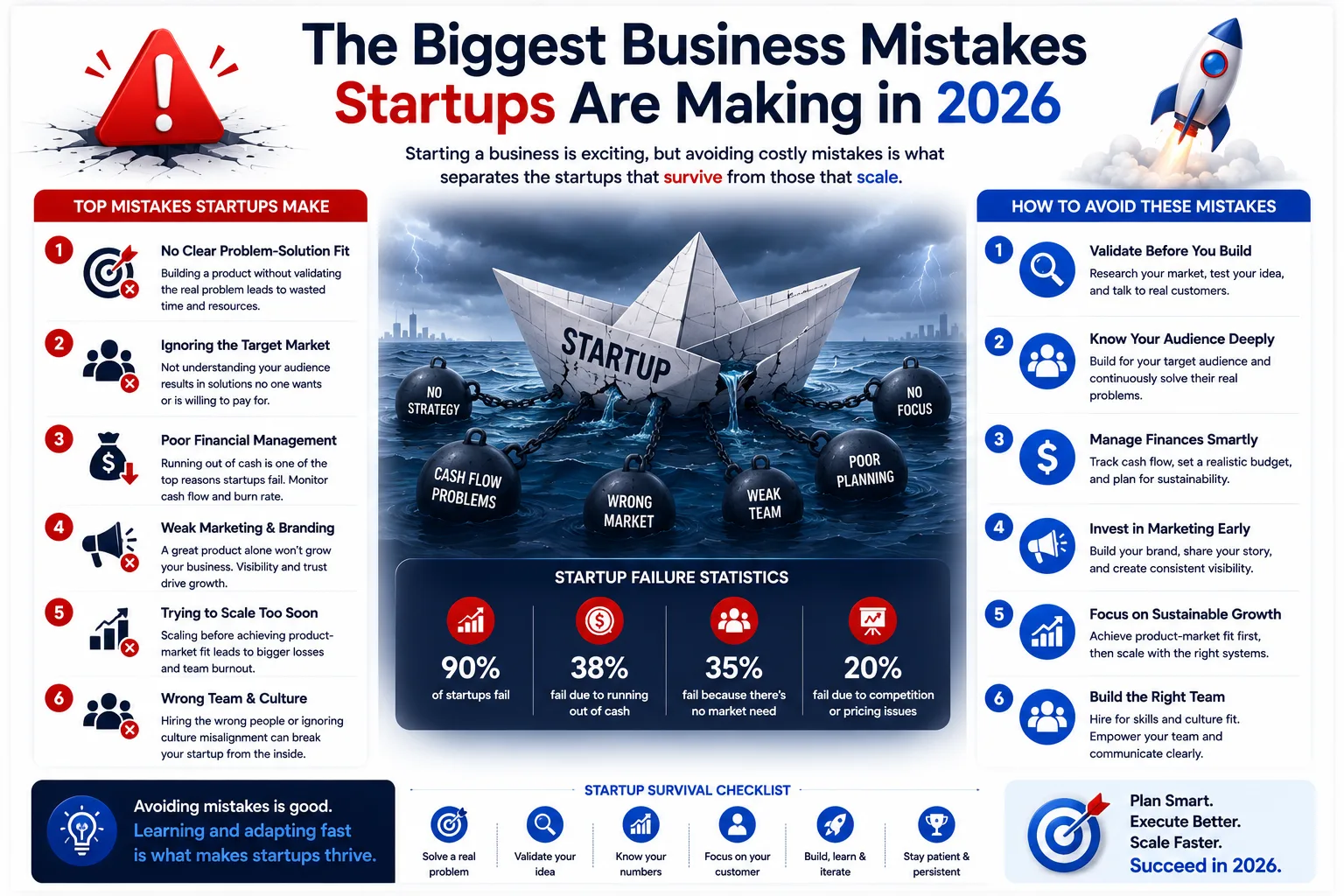
Starting a business has become easier in many ways. Technology, digital platforms, online payments, AI tools, and social media have created opportunities that did not exist a few years ago. Almost anyone with a good idea can now launch a business faster than before.
But while starting has become easier, surviving and growing has become much harder.
Every year thousands of startups enter the market with excitement, ambitious goals, and big expectations. Some build strong businesses over time, while many disappear quietly within the first few years.
The interesting part is that most startup failures do not happen because the idea itself was bad. In many cases, businesses struggle because of avoidable mistakes related to strategy, systems, branding, and long-term planning.
Bureau Verification Tools
What Are the Biggest Startup Mistakes in 2026?
The biggest startup mistakes in 2026 include poor planning, weak branding, inconsistent marketing, ignoring customer experience, scaling too quickly, and relying too heavily on trends without building strong business systems.
In 2026, the market is moving quickly, competition is increasing, and customer expectations are changing constantly. Startups making poor decisions early often struggle to recover later.
Many Startups Focus on Hype Instead of Building Real Value
One major problem today is that many startups become too focused on trends.
Some businesses spend more time trying to look successful online than actually improving their product, service, or customer experience.
Founders often chase:
- Viral marketing
- Short-term attention
- Social media hype
- Aggressive advertising
- Fast growth without structure
This may create temporary visibility, but visibility alone does not create stable business growth.
The startups surviving longer are usually the ones focused on solving real problems consistently.
Weak Branding Is Hurting Many Startups
A lot of new businesses underestimate branding completely.
Some founders think branding only means logos, colors, or social media design. But branding in 2026 affects how customers trust and remember businesses.
Customers now research businesses online before making decisions.
If a startup looks inconsistent, confusing, or unprofessional digitally, customers often move to competitors immediately.
Trust Is Becoming More Important Than Marketing
People pay attention to:
- Customer reviews
- Website quality
- Communication style
- Transparency
- Online reputation
- Consistency across platforms
Strong branding helps businesses create trust faster in crowded industries.
Many Startups Ignore Customer Experience
One of the biggest startup mistakes is focusing too heavily on getting customers while ignoring what happens after the first interaction.
Modern customers expect:
- Fast communication
- Easy support
- Smooth user experience
- Clear pricing
- Professional service
Businesses providing poor customer experience usually struggle with retention even if they generate good traffic initially.
Customer Retention Is More Valuable Than Constant Acquisition
Many startups spend huge amounts on ads while existing customers quietly lose interest because of weak service or communication.
Businesses growing sustainably usually invest heavily in customer satisfaction and long-term relationships.
Scaling Too Fast Is Becoming a Serious Problem
Some startups try to scale aggressively before building proper systems.
This creates operational problems very quickly.
Businesses start facing:
- Delayed responses
- Poor coordination
- Delivery issues
- Customer complaints
- Financial pressure
- Team confusion
Growth without structure often creates instability instead of success.
Strong Systems Matter Early
Startups that scale successfully usually build systems early for:
- Workflow management
- CRM tracking
- Financial monitoring
- Customer support
- Communication processes
- Operational organization
Without structure, businesses become difficult to manage as customer volume increases.
Poor Financial Planning Is Damaging Startup Growth
A surprising number of startups generate revenue but still struggle financially.
One reason is poor financial planning.
Some founders underestimate:
- Operational costs
- Advertising expenses
- Hiring requirements
- Software subscriptions
- Customer acquisition costs
Others spend heavily too early without stable income foundations.
Cash Flow Problems Are Common
Many startups fail because they run out of cash during growth stages even if customer interest exists.
Businesses that monitor spending carefully usually survive longer during difficult periods.
Businesses Are Depending Too Much on Ads Alone
Paid advertising has become extremely competitive in 2026.
Some startups depend entirely on advertisements without building organic growth channels.
This creates risk because advertising costs continue increasing.
Long-Term Visibility Matters
Businesses building sustainable growth are usually investing in:
- SEO content
- Branding
- Customer trust
- Organic traffic
- Community building
- Referral systems
Those channels often become more stable over time compared to relying only on paid campaigns.
Some Startups Are Overusing AI Without Human Quality Control
AI tools are helping startups improve productivity, but some businesses are becoming too dependent on automation.
A growing number of startups publish:
- Generic AI content
- Repetitive communication
- Automated customer interactions without oversight
This often makes businesses feel less authentic.
Customers still connect more strongly with businesses showing human understanding, real experiences, and original communication.
Founders Are Burning Out Faster
Another major issue startups face today is founder burnout.
Many business owners try to handle everything themselves for too long.
This creates stress, poor decision-making, and inconsistent operations.
Delegation and Systems Matter
Businesses become more stable when founders gradually build:
- Clear processes
- Organized workflows
- Reliable teams
- Operational systems
Trying to control every detail personally often slows growth over time.
Adaptability Is Becoming Essential
Markets are changing rapidly.
Customer behavior, technology, digital platforms, and business trends continue evolving quickly.
Startups refusing to adapt often struggle against competitors moving faster.
Businesses Need Continuous Learning
Successful startups are constantly reviewing:
- Customer feedback
- Market trends
- Technology shifts
- Competitor strategies
- Business performance
That adaptability is becoming one of the biggest advantages in modern business.
The Startups Growing Strongly Usually Focus on These Things
Businesses scaling successfully in 2026 usually prioritize:
- Strong customer experience
- Clear branding
- Financial discipline
- Long-term growth
- Efficient systems
- Adaptability
- Trust and consistency
Most successful startups are not built overnight. They usually grow through continuous improvement and stable execution.
Final Thoughts
The startup world in 2026 is full of opportunity, but it is also more competitive and demanding than ever before.
Most business mistakes today are not caused by lack of ambition. They happen because businesses grow without structure, chase trends without strategy, or focus too much on short-term visibility instead of long-term stability.
The startups surviving and scaling successfully are usually the ones building strong systems, protecting customer trust, adapting quickly, and focusing on sustainable growth rather than temporary hype.
That long-term mindset is becoming one of the biggest differences between businesses that last and businesses that disappear quickly.
FAQ
What are the biggest startup mistakes in 2026?
Poor planning, weak branding, scaling too quickly, ignoring customer experience, and depending too heavily on trends are major startup mistakes.
Why do startups struggle to grow?
Many startups struggle because they lack systems, financial planning, customer retention strategies, and operational structure.
Is branding important for startups?
Yes, branding helps startups build trust, improve visibility, and stand out in competitive markets.
Why is customer experience important for startups?
Customer experience affects trust, retention, reviews, referrals, and long-term business growth.
Can AI help startups grow faster?
AI tools can improve productivity and efficiency, but businesses still need human creativity, strategy, and quality control.
Discussion & Feedback
Join The Discourse
Comments are reviewed for technical quality.